
A What If
 On a recent visit to the official James Thurber website, I found this entry: “An Amusing Thought: What If Thurber Illustrated Many Moons?” It concerns a drawing found by Thurber’s granddaughter, Sara Thurber Sauers at Yale’s Beinicke Library.
As much as I’ve always enjoyed Louis Slobodkin’s illustrations for Thurber’s Many Moons (published in 1943), I would’ve preferred, of course, to see Thurber drawings.
Ms. Sauers’ Beinicke find shows us that Thurber’s line was, at that particular time, somewhat confident. Look at this dog in the drawing:

You can see that he was inking in over pencil guidelines, as was often his custom. I detect a look of concentration to the lines. They’re drawn as if in very slow motion, rather than giving the appearance of the pen skating over the paper that we see in earlier work. Still, it’s a classic Thurber dog, a real beauty — though sans nose(!).
If you look at the entire drawing (you can see it by linking above), you’ll notice the only obvious hesitant line — more of a mild squiggle — is evident in how Thurber handled the King’s crown and throne, especially the backrest.

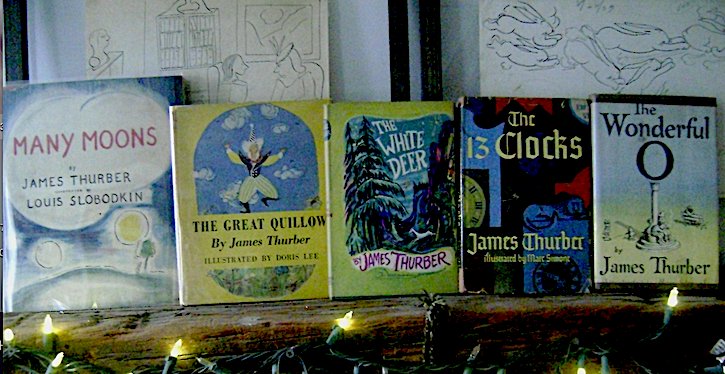
Squiggles or no squiggles, it’s a charming drawing. But alas! Our Thurber history tells us that his eyesight had dramatically worsened by the early 1940s; the prospect of illustrating an entire book most certainly would’ve been quite a challenge for him (he did continue to draw as his sight deteriorated — his last known published drawing appeared on the cover of TIME magazine in 1951). Many Moons was the first of his books to be illustrated by another artist (I’m showing you the complete line-up, in chronological order, left to right, below).
_____________________________________________________________

James Thurber Born, Columbus, Ohio, December 8, 1894. Died 1961, New York City. New Yorker work: 1927 -1961, with several pieces run posthumously. According to the New Yorker’s legendary editor, William Shawn, “In the early days, a small company of writers, artists, and editors — E.B. White, James Thurber, Peter Arno, and Katharine White among them — did more to make the magazine what it is than can be measured.”
Key cartoon collection: The Seal in the Bedroom and Other Predicaments (Harper & Bros., 1932). Key anthology (writings & drawings): The Thurber Carnival (Harper & Row, 1945). There have been a number of Thurber biographies. Burton Bernstein’s Thurber (Dodd, Mead, 1975) and Harrison Kinney’s James Thurber: His Life and Times (Henry Holt & Co., 1995) are essential. Website